The aim was to develop a fully automated conveyor and material flow solution for the removal, testing and final inspection of refrigerators in series production.
Conveyor technology for testing and evacuation processes in the manufacture of refrigeration appliances
Client project
Key technical specifications
| Conveyed goods | Cooling unit on polystyrene floor |
| Measures | (538 + 556)mm x 500mm x (711 – 1920)mm (LxWxH) |
| Weight | max. 120 kg |
| Conveying direction | transverse/ longitudinal |
| Cycle time | < 40 s |
| Installation site | Dry operation in closed rooms |
| Ambient temperature | 15 °C – 40 °C |
Three-tier material flow architecture
Lift converters, vertical conveyors and an intelligent workpiece carrier system working in tandem
Background and objectives
Evacuation circuit
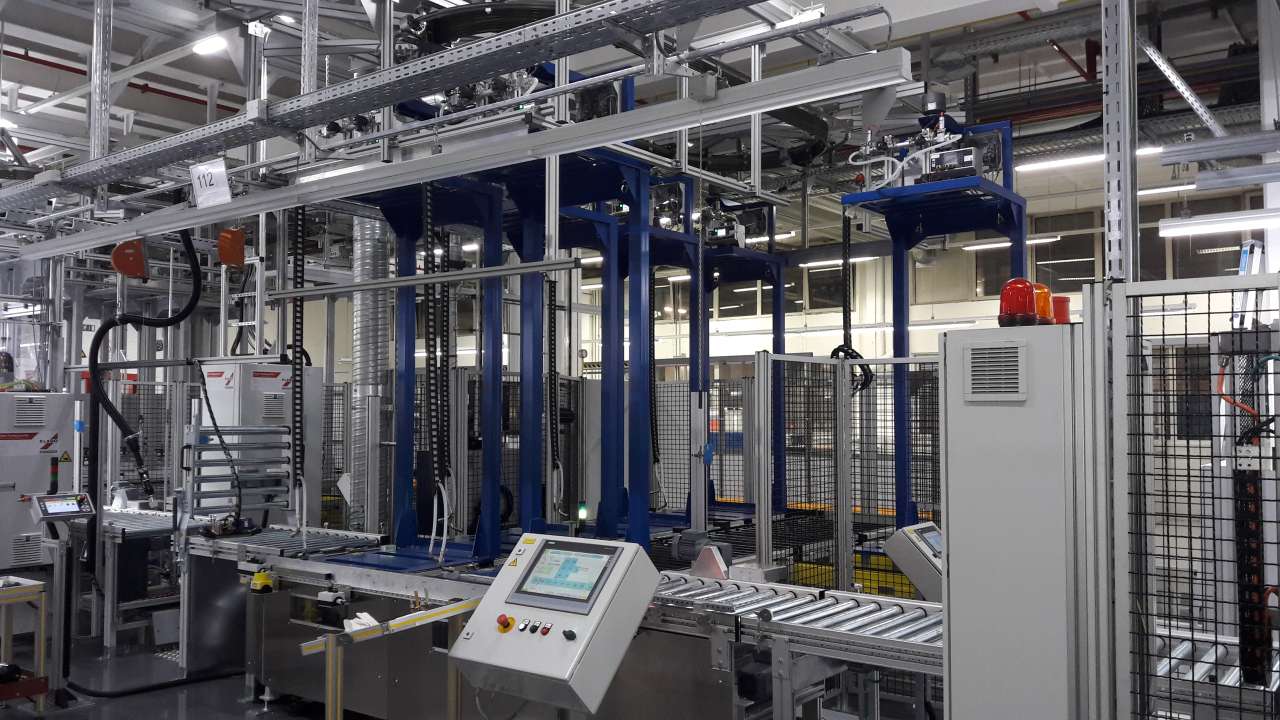
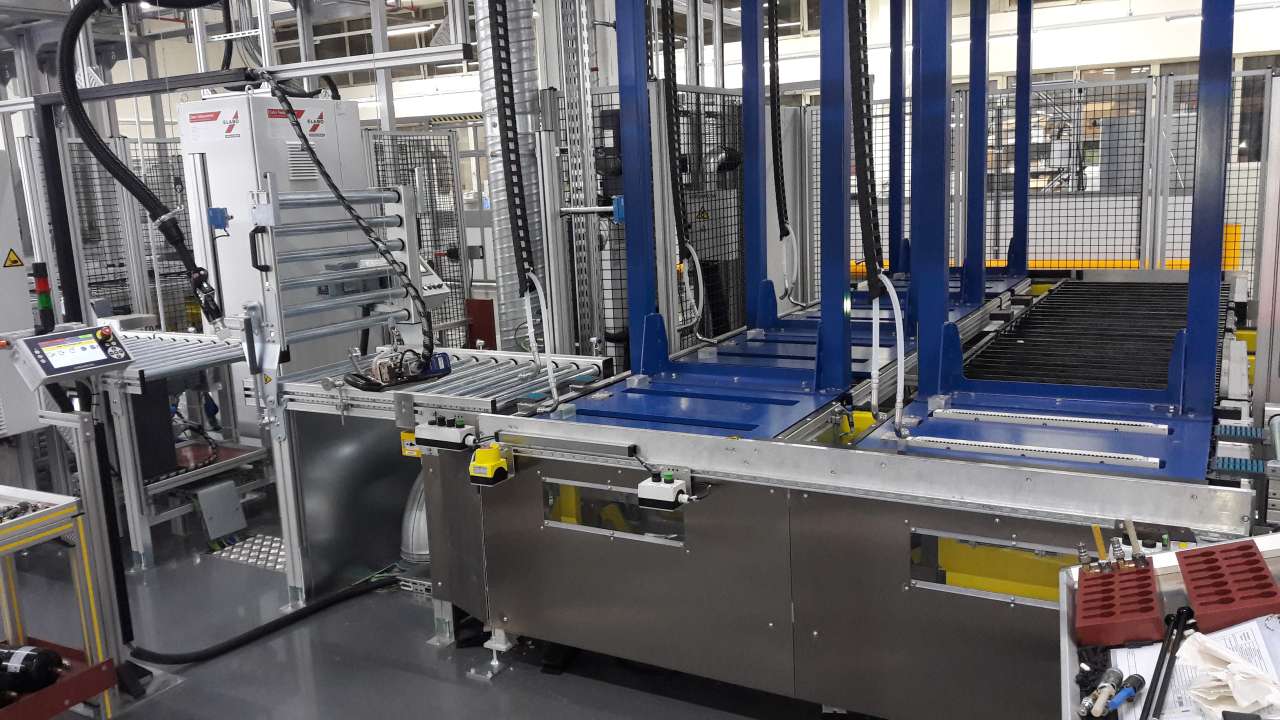
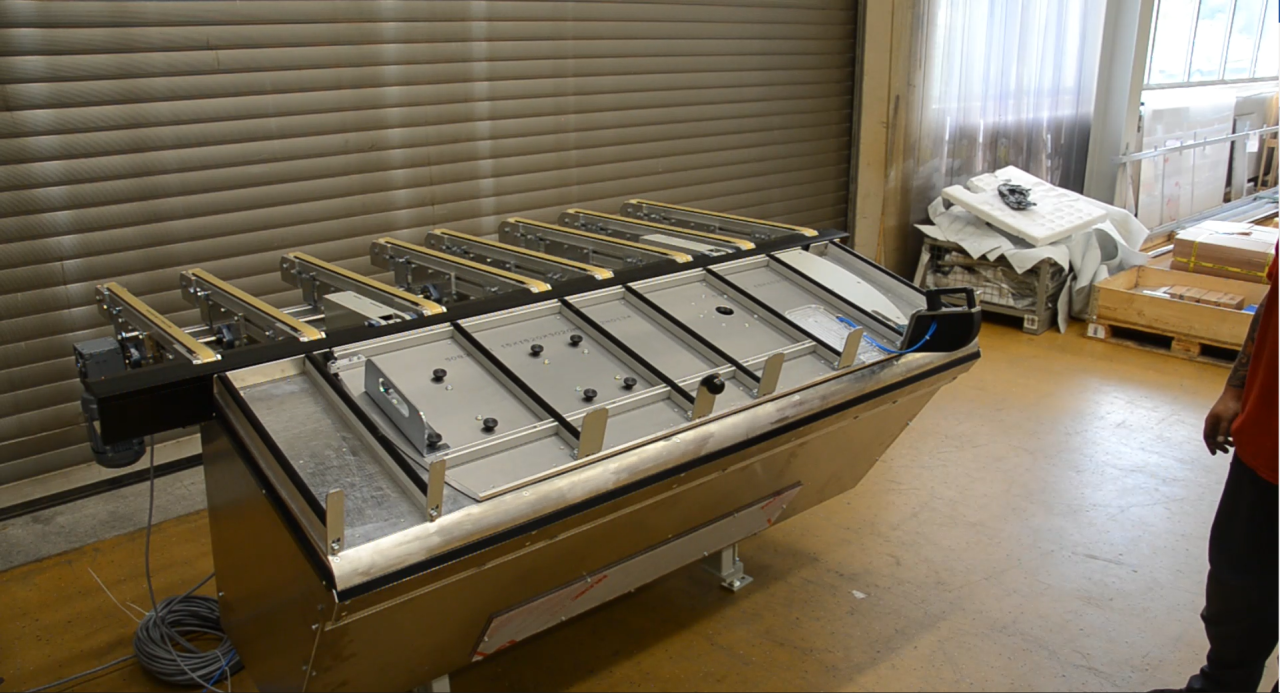
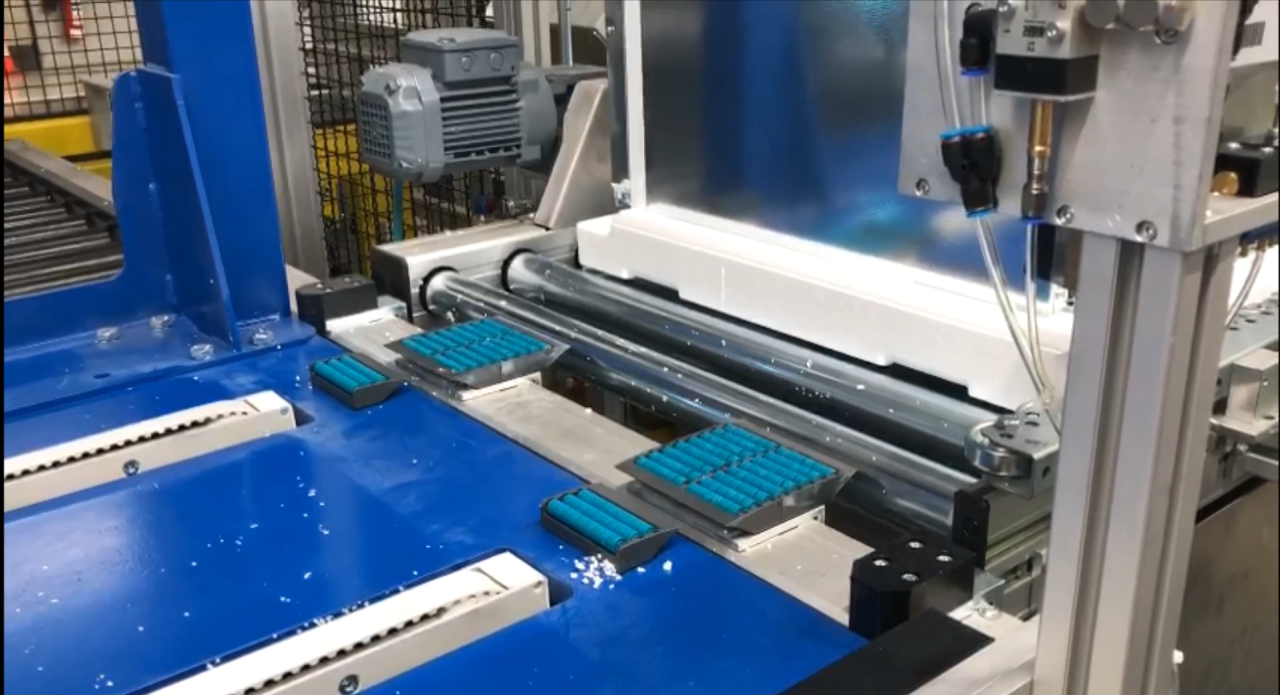
Upon leaving the final assembly line, the cooling units are transferred with precision into the evacuation circuit. Lifting, transfer and alignment stations position each unit exactly onto specially equipped workpiece carriers fitted with integrated evacuation pumps.
Once the evacuation hoses have been automatically connected, the defined cycle begins. The units pass through the circuit in accordance with the specified evacuation time. As soon as the target parameters are reached, the units are automatically disconnected. The material flow moves seamlessly on to the next station.
Test circuit
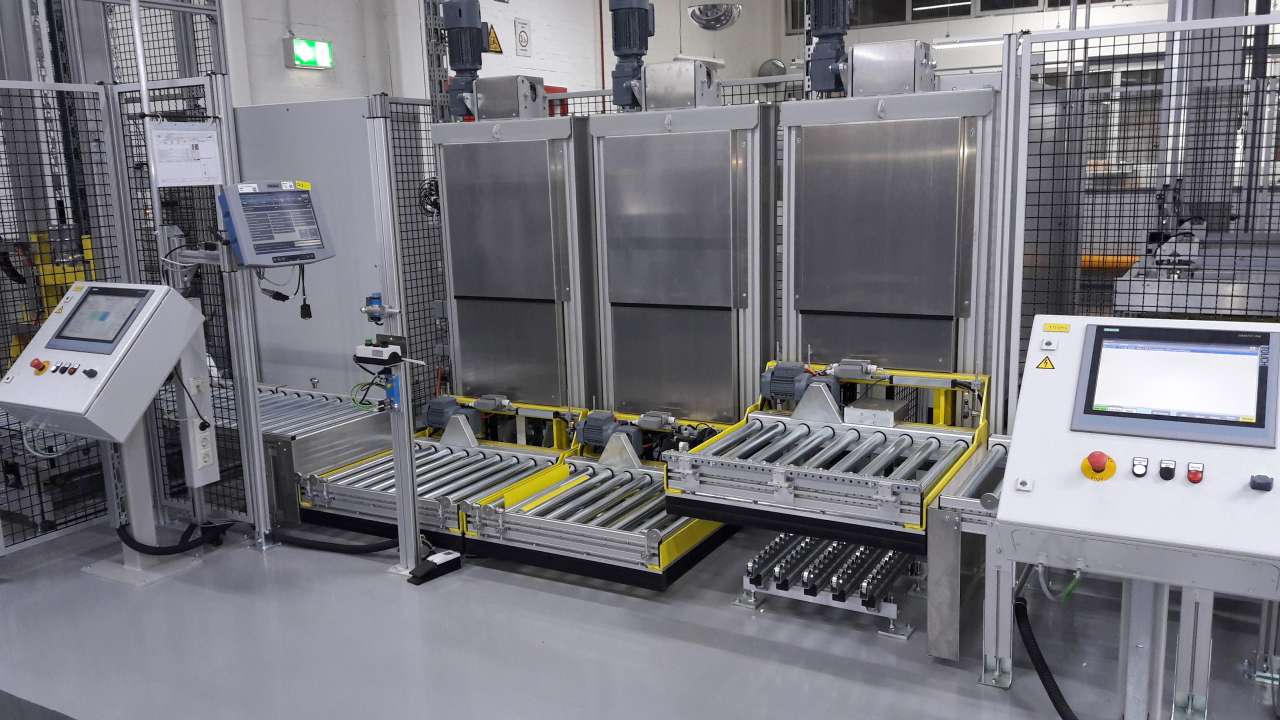
In the subsequent test cycle, workpiece carriers equipped with integrated test technology take over the devices. Electrical contact is established fully automatically and in a reproducible manner. After the test cycle, the devices are automatically disconnected and transported away from the workpiece carriers.
Deviations from defined target values are uniquely assigned to the respective device via barcode identification. Defective units are automatically diverted during the subsequent conveying process and directed to the rework process – without manual intervention and without interrupting the cycle.
Final inspection
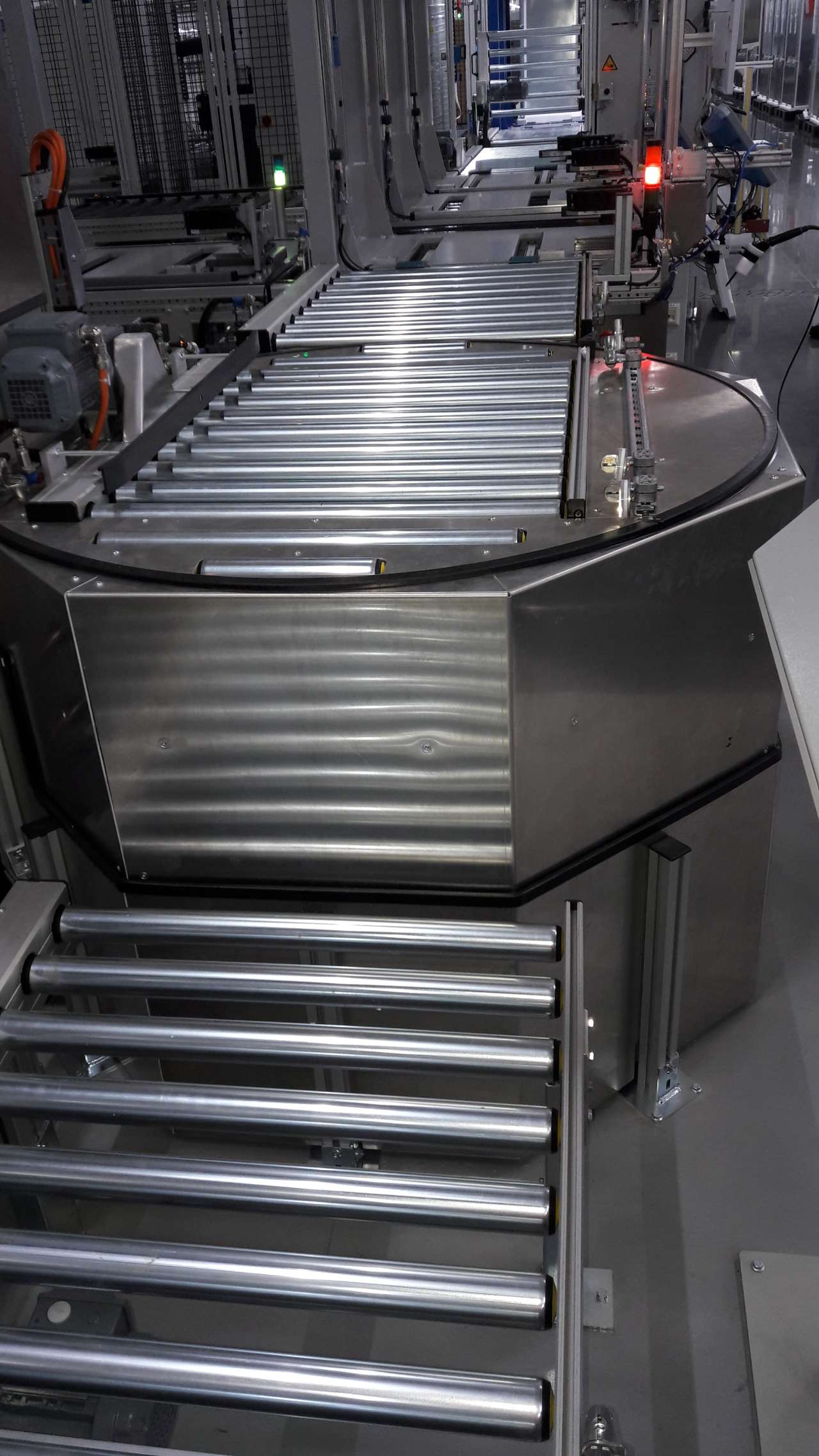
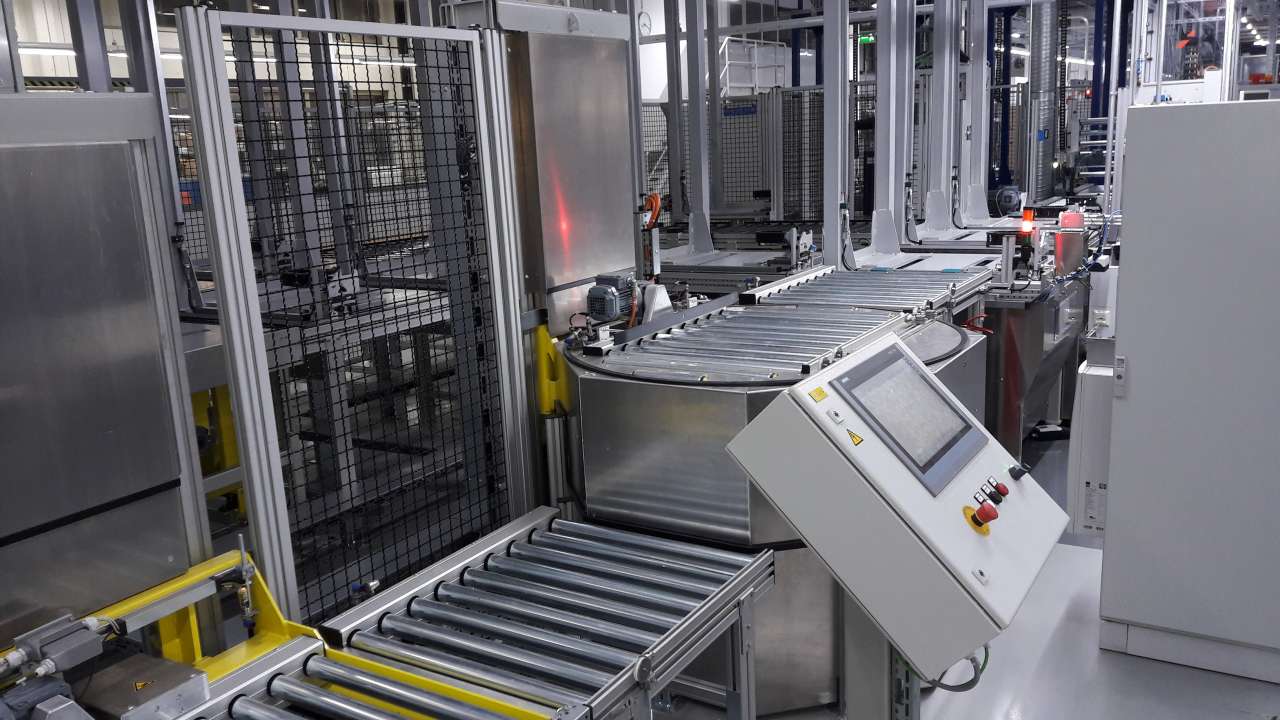
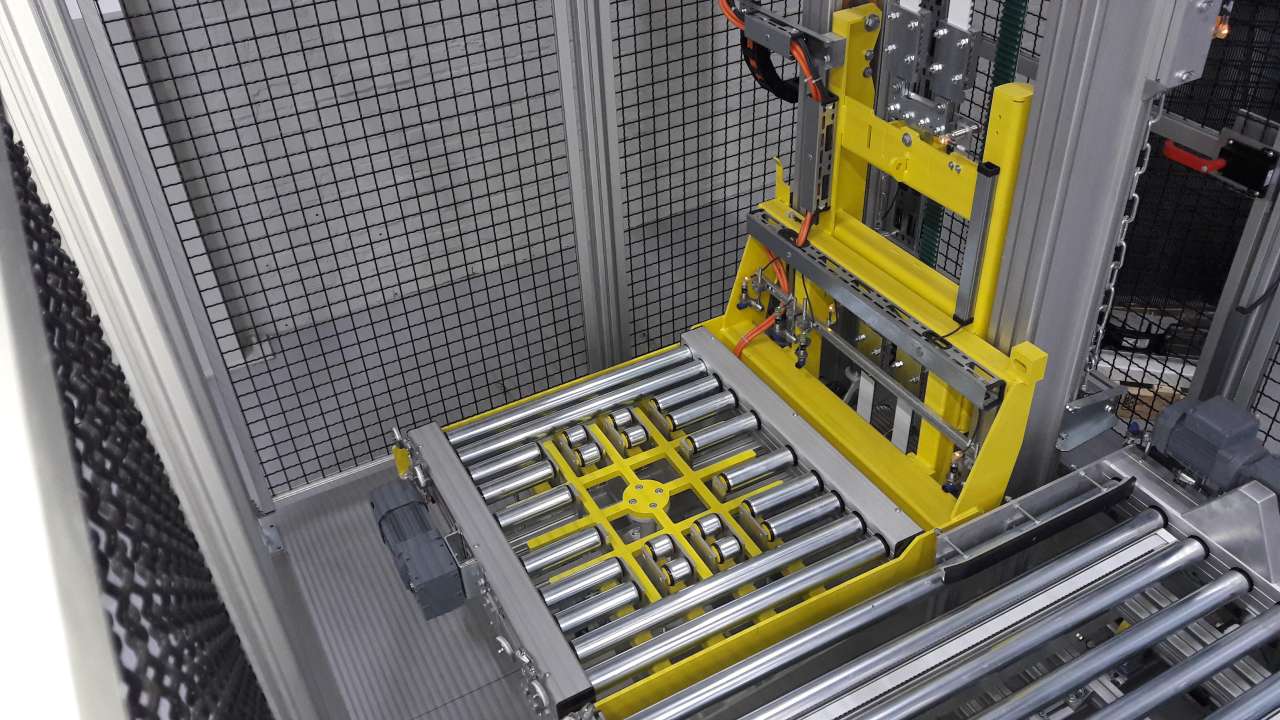
Further along the line, an integrated rotating station ensures that the devices are correctly aligned for the process. A vertical conveyor then raises them to an ergonomic working height for final inspection. Here too, alignment, electrical connection and final testing are carried out under controlled conditions.
Once the final inspection has been passed, the devices are realigned via a vertical conveyor, rotated for onward transport and transferred to a buffer. The material flow remains continuous, synchronised and process-stable throughout.
Among other things, the solution enables our client to:
Clock-stable evacuation processes
Automated fault detection
Ergonomically optimised final inspection
Reliable ejection of faulty devices
Space-efficient system architecture
Gallery
Detailed insights into conveyor technology for refrigeration units
Videos
Vertical conveyors, vertical lifts and vertical transfer units in action
Conveyor system components
The complete system – planned, designed and manufactured by TEGEL-TECHNIK – includes, amongst other things:
The conveyor technology is complemented by a comprehensive control and drive system, including:
Circuit diagram design
Control panel construction
System installation
Software development
Visualisation
Commissioning
Production support
In addition to the conveyor system, the scope of supply also included workpiece carriers with integrated evacuation and testing technology, as well as identification and control systems.
Customised conveyor systems tailored to your processes
Are you planning a new conveying solution or looking to optimise existing processes?
TEGEL-TECHNIK supports you throughout every stage of your project – offering expert advice and precise planning for your material handling systems. From the initial concept through detailed planning to on-site commissioning, whether at your factory or at your customers’ premises, we are your reliable partner in the implementation of national and international projects.
Contact us for a bespoke material handling solution.
Phone
+49 7322 9611–0FAQ – Conveyor technology for testing and evacuation processes in refrigeration appliance production
An automated evacuation and testing system in refrigeration appliance production is an integrated material flow system that combines evacuation, functional testing and onward transport within a mass production process.
Following final assembly, the refrigeration units are transferred to a workpiece carrier system. The refrigerant lines are purged of air in the evacuation circuit. The units then undergo a test cycle during which electrical and functional parameters are recorded automatically.
The entire process is cycle-controlled and synchronised, ensuring that evacuation time, test time and material flow are precisely coordinated.
Conveyor systems in refrigeration appliance production must accommodate different appliance heights and weights, as well as variable conveying orientations.
Furthermore, short cycle times, high process stability and precise positioning are crucial. The system must enable the reliable integration of evacuation and testing technology whilst ensuring a continuous flow of materials.
In addition, ergonomic considerations and defined environmental conditions during dry operation play an important role.
A workpiece carrier system serves as the central interface between conveyor technology and process technology. It not only transports the cooling unit but also positions it in a repeatable manner for evacuation and testing.
Thanks to the secure mounting of the unit, automatic connections, hose couplings and testing procedures can be carried out reliably. At the same time, the workpiece carrier system enables clear identification of each individual product within series production.
This significantly improves quality assurance and traceability.
Lift transfer units and vertical conveyors are key components in complex material flow systems.
Lift transfer units enable workpiece carriers to be lifted and transferred laterally between different conveyor lines. This allows for the creation of loops, branches and parallel process stations.
Vertical conveyors handle transport between different levels. They enable a space-efficient plant layout and create ergonomically optimal working positions for testing and inspection processes.
The cycle time in automated conveyor systems is ensured by a carefully coordinated combination of mechanical conveying technology, workpiece carrier systems and intelligent control systems.
All process steps – evacuation, inspection, rotation and onward transport – are synchronised. Sensors and control technology monitor the position of each device in real time.
This integration ensures a continuous material flow whilst reliably maintaining process parameters. The result is stable series production with defined lead times.