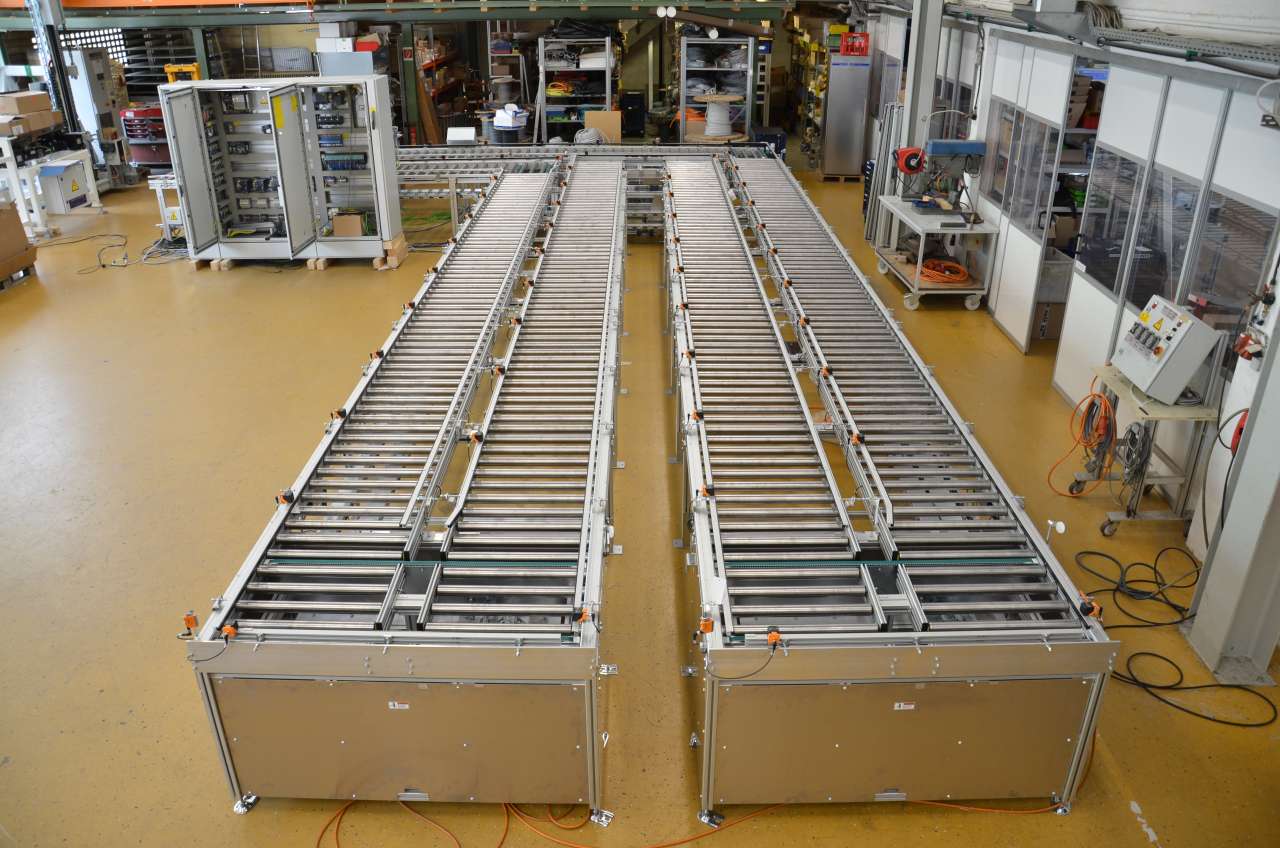
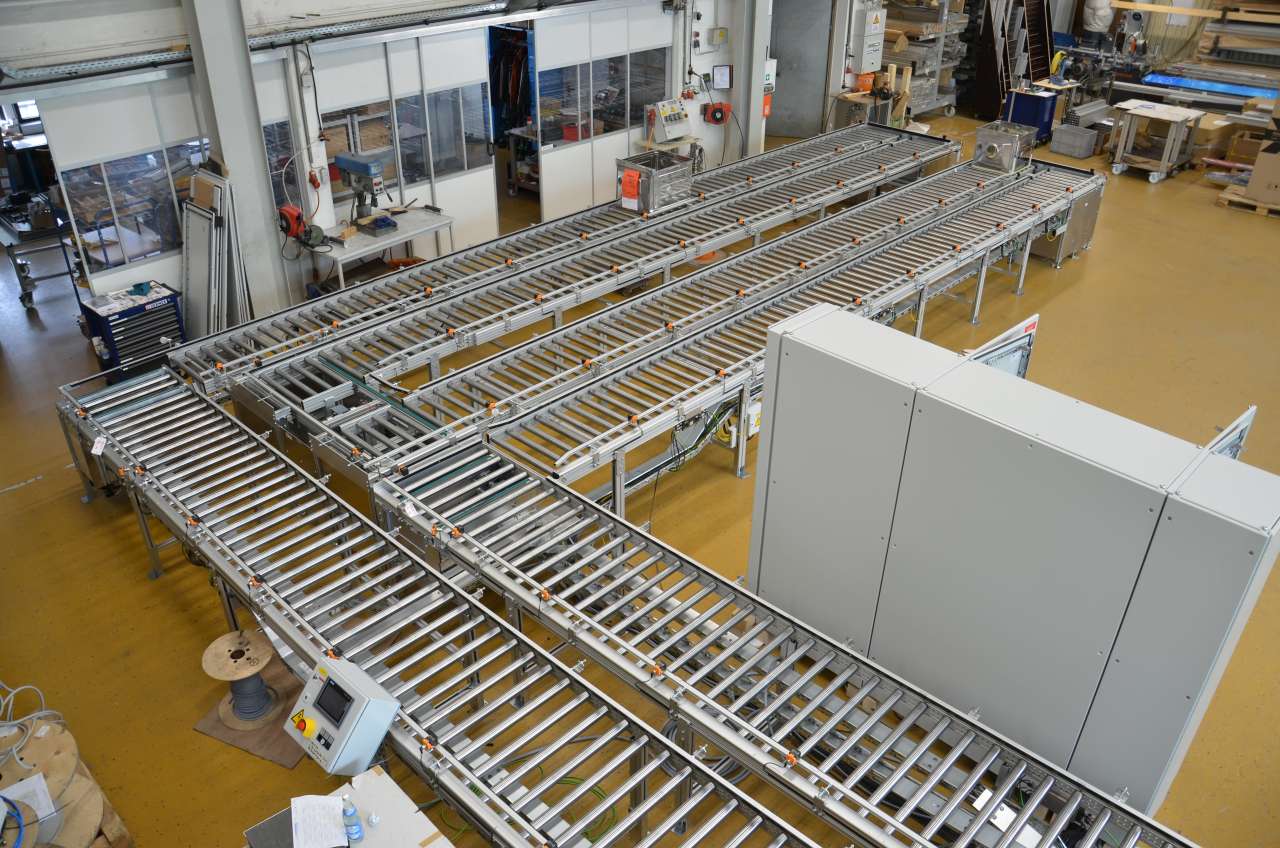
In the series production of dishwasher interiors, components must be transported and buffered reliably with a cycle time of 18 seconds. At the same time, integration into existing production layouts requires a flexible conveying direction and a space-saving system architecture.
The aim was to develop an automated conveying solution that reliably integrates material flow, direction changes and buffering within household appliance production.
Conveyor technology for dishwasher racks
Client project
Key technical specifications
| Conveyed goods | Dishwasher liner |
| Measures | 700mm x 650mm (LxW) |
| Weight of the conveyed goods | max. 10kg |
| Cycle time | 18s |
| Conveyor direction | transverse / longitudinal |
| Ambient temperature | 18°C – 35° |
Conveyor system solution for gentle material handling in dishwasher production
Lift conveyors, roller conveyors and toothed belt conveyors working in tandem
Background and objectives
Space-saving conveyor system with integrated direction change
The conveyor system combines powered roller conveyors with integrated vertical transfer units within a continuous material flow structure.
By integrating the vertical transfer units into the conveyor route, a 90° change of direction can be achieved directly during the ongoing process. This eliminates the need for additional conveyor sections, resulting in a space-efficient layout integration into existing production lines.
Precise, synchronised buffering and gentle component handling
Toothed belt conveyors are used to ensure the gentle transport of the inner containers. These ensure that sensitive components are handled appropriately during series production.
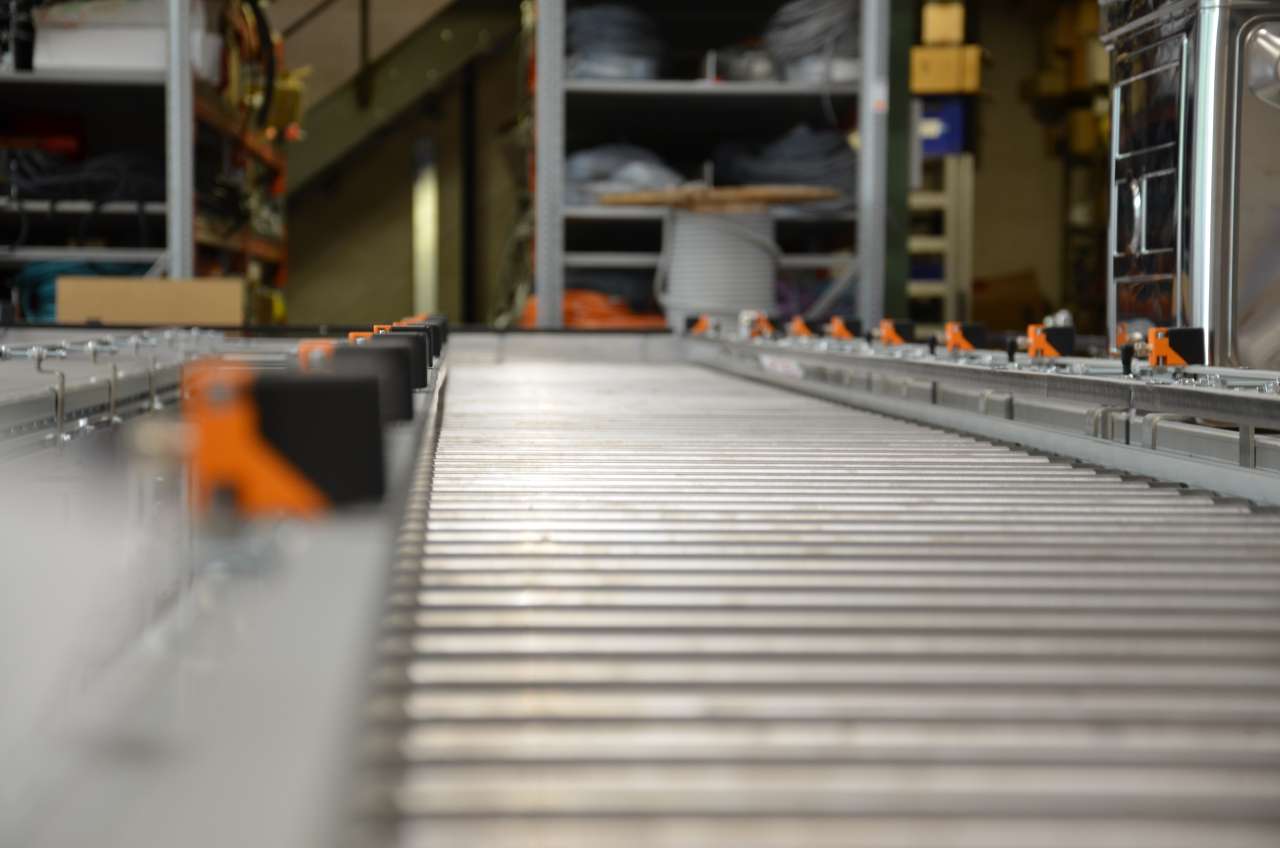
Single-station sections with motorised rollers enable controlled separation and precise cycle timing. This keeps the material flow stable and synchronised, even with short cycle times.
Among other things, the solution enables our client to:
Rhythm-stable series production of dishwasher inner tubs
Space-efficient integration into existing production layouts
Space-saving change of direction in the material flow
Controlled buffering between production steps
Gentle component transport in household appliance manufacturing
Gallery: Examples of Use
An insight into conveyor systems for industrial material flow
Components of conveyor systems for dishwasher racks
The complete system – planned, designed and manufactured by TEGEL-TECHNIK – includes, amongst other things:
Hardware and software, including circuit diagram design, control cabinet construction, system installation, software development, system visualization, commissioning, and production support
Customised conveyor solutions for series production
Are you planning a new conveyor system for the production of household appliances, or would you like to make your existing material flows more efficient?
TEGEL-TECHNIK develops automated conveying and material flow systems that are precisely tailored to your cycle times, component geometries and layout requirements. From the initial analysis of your production processes through to technical design and commissioning, we provide you with comprehensive, practical support.
Whether it’s a change of direction in the material flow, cycle-accurate buffering or space-saving integration into existing lines – we implement solutions that fit seamlessly into your series production.
Talk to us about your requirements. Together, we will develop a conveying solution that suits your production environment.
Phone
+49 7322 9611–0FAQ – Conveyor systems for dishwasher racks
In the mass production of domestic appliances, dishwasher inner tubs are transported via automated conveyor systems. These systems not only ensure the continuous movement of components but also enable precise, cycle-timed buffering between individual production stages.
Depending on the layout requirements, the material flow can be transverse or longitudinal and can be flexibly integrated into existing production lines.
A change in the direction of material flow is often achieved using integrated lifting transfer systems within the conveyor line.
In this process, the material is lifted and transferred in a controlled manner to a new conveying direction. This solution eliminates the need for additional conveyor sections and allows for space-saving integration into complex production layouts.
In the mass production of dishwashers, buffer sections are used to compensate for process fluctuations and prevent production stoppages.
Segmented conveyor sections allow each component to be stopped or moved on as required. This increases process reliability and ensures an even workload for the downstream stations.
Conveyor systems used in the manufacture of domestic appliances must accommodate components of varying sizes, weights and conveying directions.
In addition to mechanical stability, gentle component handling, flexible layout integration and reliable cycle control are particularly crucial. The conveyor technology must integrate seamlessly into existing production environments and operate with consistent process stability over the long term.