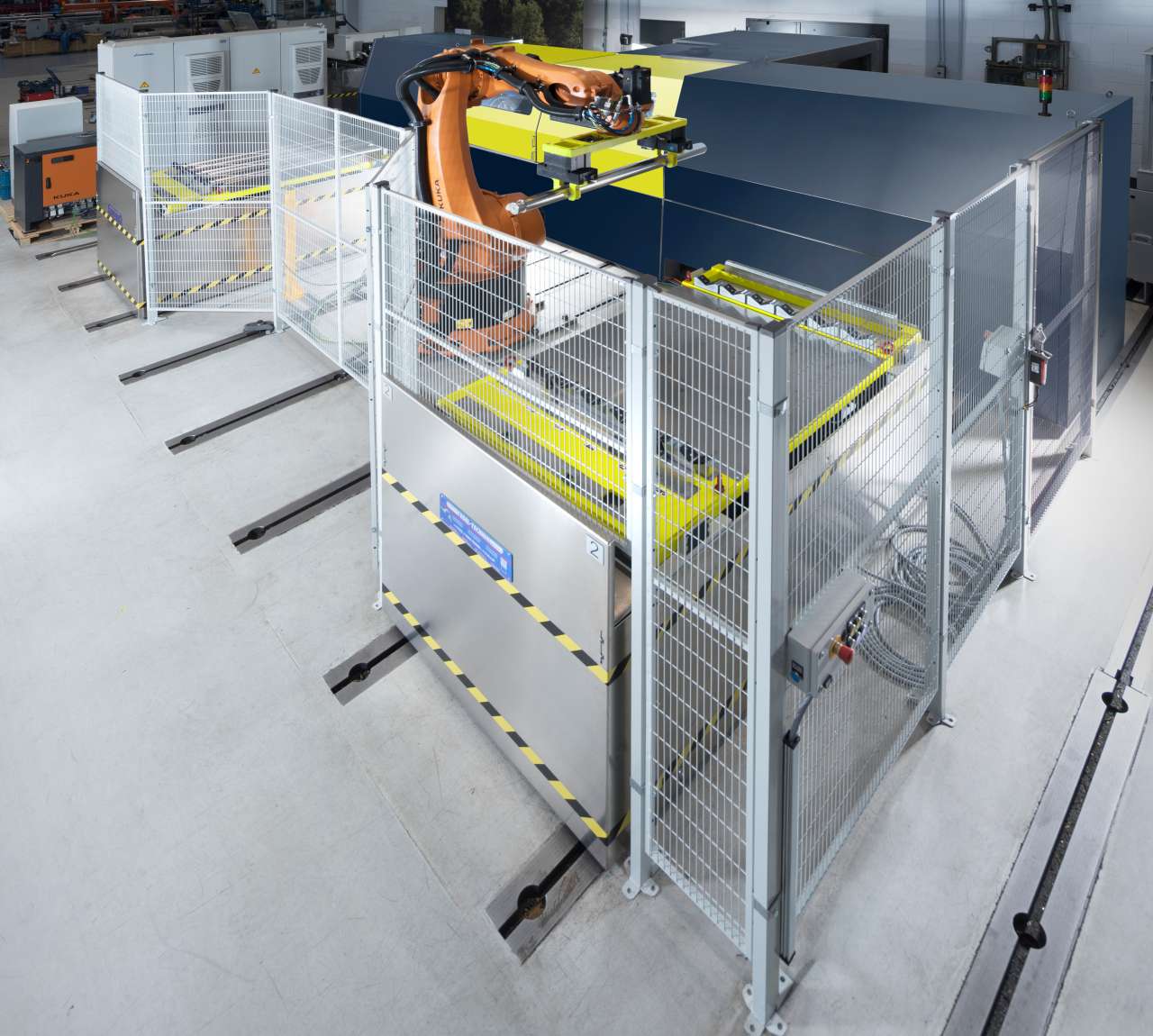
In the automated grinding of round materials, pipes with a diameter of 78 to 108 mm and weighing up to 130 kg per workpiece must be fed reliably into a robot cell.
Feeding should take place outside the safety fence area, whilst removal and machining are carried out fully automatically within the robot cell.
The aim was to develop a robust conveyor system solution for robotic applications that combines manual loading and unloading, crane handling and automated machining within a closed-loop process.
Telescopic fork for a robot cell
Client project
Key technical specifications
| Conveyed goods | Special racks (forklift or crane loading possible) |
| Workpiece carriers with prism holders for the actual workpieces are located on the racks | |
| Pipe dimensions | SZ1 Ø 78 to 108 mm with length 1,760 mm |
| SZ2 Ø 78 to 108 mm with length 1.532 mm | |
| Weight/ tube | SZ2 Ø 78 to 108mm with length 1.532 mm |
| Conveying direction | lengthwise |
| Installation site | Dry operation in closed rooms |
| Ambient temperature | 15 °C – 40°C |
| Special environmental influences | none |
Conveyor systems for robotic cells for feeding round stock
Custom design with telescopic fork and workpiece carrier system
Background and objectives
Automated feeding using a telescopic fork
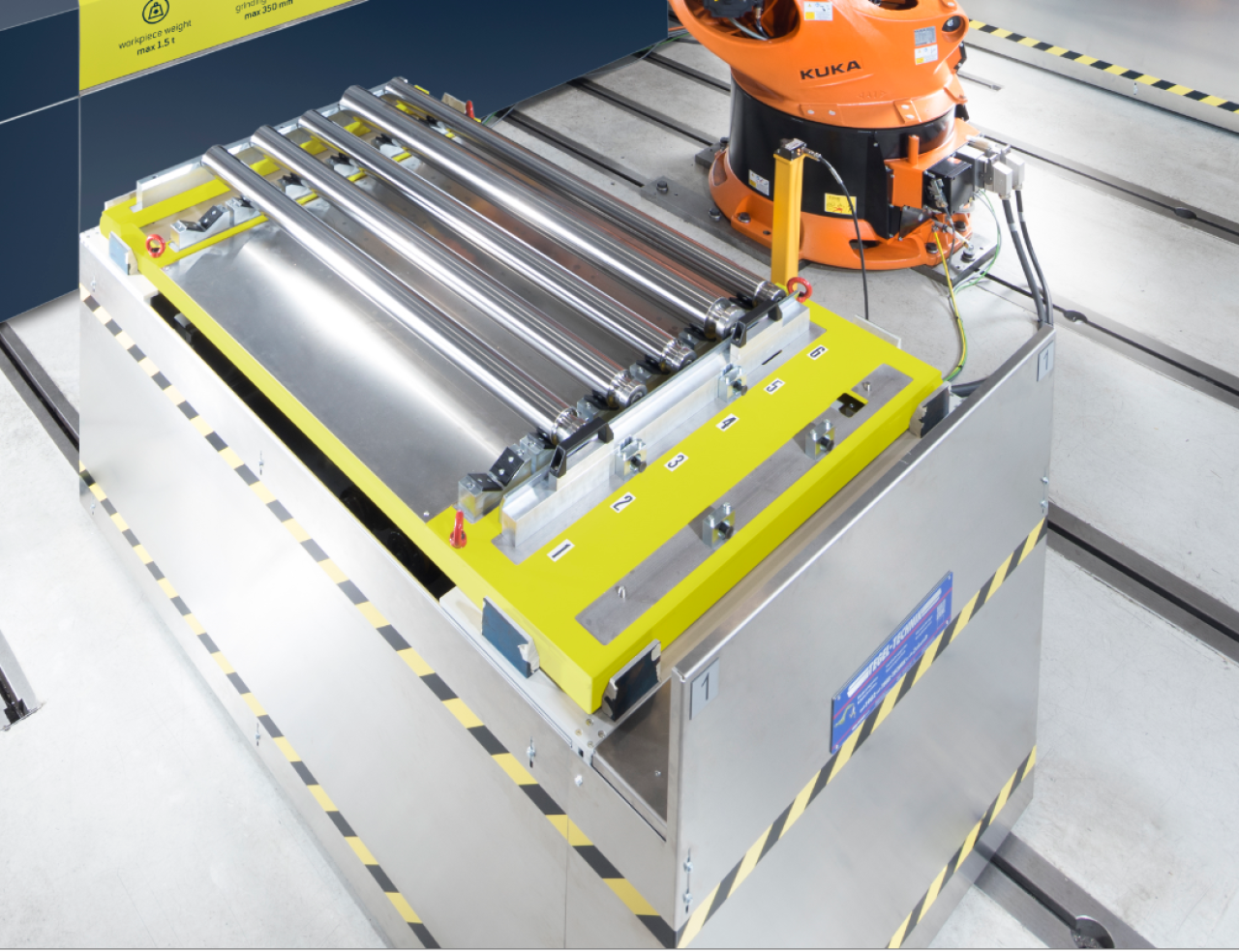
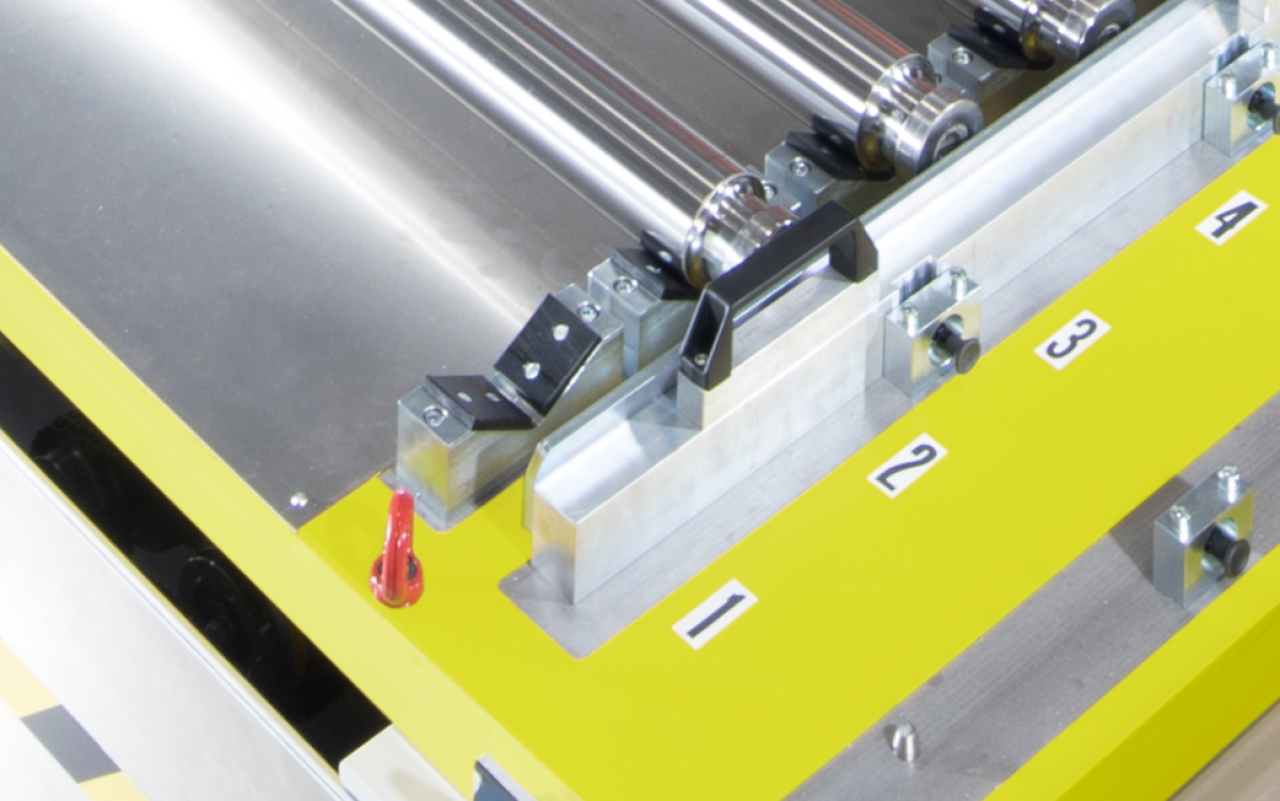
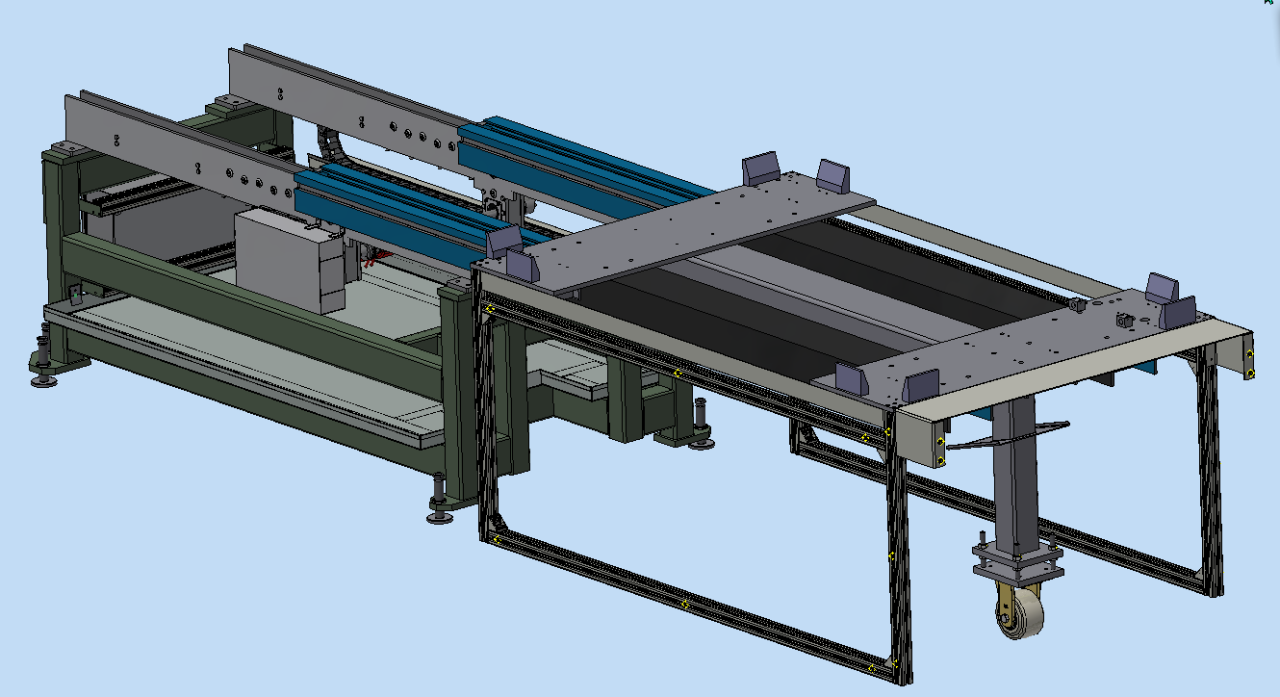
At the heart of the solution is a specially developed telescopic fork, which forms part of a custom-built design. The telescopic fork is mounted on a sturdy steel base frame anchored to the floor and is designed to handle loads of up to 1.5 tonnes. It offers an extension stroke of 2,350 mm. Mounted on the fork is a sturdy steel frame with prism-shaped sockets for the round materials. Guide plates make it easier for the operator to load the extended system with precision. To support the extended telescopic fork, an additional support roller extends to ensure even load distribution.
Material handling between the operator area and the robot cell
The yellow steel frame is positioned onto the extended telescopic mount via four attachment eyes using an overhead crane. Once in place, the telescopic rail moves the loaded frame back into the protected working area of the robot cell.
The robot removes the round materials one by one, performs the grinding operation and places the machined workpieces back into the steel frame. The telescopic fork then moves the finished batch out of the safety fence area. The operator removes this using the overhead crane and loads a new batch.
Among other things, the solution enables:
Reliable material feeding in robotic cells
Combination of crane handling and automated conveyor technology
Load capacity of up to 1.5 tonnes with a 2,350 mm reach
Ergonomic loading and unloading outside the safety zone
Reliable integration into grinding machine applications
Gallery
From design to commissioning – the construction process in pictures.
Customised conveyor systems for robotic applications
Are you planning to automate the feeding of heavy workpieces into a robot cell, or do you require a bespoke design for your material handling needs?
TEGEL-TECHNIK develops conveyor systems for robotic applications that are precisely tailored to component weight, geometry and process requirements. We provide comprehensive support for your project, from the initial design and integration into existing robot cells right through to commissioning.
Talk to us about your requirements. Together, we will implement a conveyor system solution for your robot cell.
Phone
+49 7322 9611–0FAQ – Conveyor systems for robot cells with telescopic forks
Heavy workpieces can be automatically fed into robot cells using telescopic fork systems or specialised conveyor solutions. Loading takes place outside the safety fence, whilst the robot operates within the secured area.
A telescopic fork offers a long stroke length whilst maintaining a compact design. It is particularly suitable for applications where heavy workpieces need to be moved safely in and out of protected robotic areas.
Separation is achieved by means of safety fencing systems and the extension and retraction of the telescopic fork. The operator remains outside the danger zone whilst the robotic processing takes place automatically.
This type of conveyor system for robotic cells is frequently used in metalworking, grinding, mechanical engineering and automated mass production.